
СРАВНИТЕЛЬНЫЙ АНАЛИЗ ЯЗЫКОВЫХ СРЕДСТВ РЕПРЕЗЕНТАЦИИ РЕЛИГИОЗНЫХ КОНЦЕТОВ В РУССКОМ И АНГЛИСКОМ ЯЗЫКАХ
СРАВНИТЕЛЬНЫЙ АНАЛИЗ ЯЗЫКОВЫХ СРЕДСТВ РЕПРЕЗЕНТАЦИИ РЕЛИГИОЗНЫХ КОНЦЕТОВ В РУССКОМ И АНГЛИСКОМ ЯЗЫКАХ

Аннотация
В статье представлен сравнительный анализ вербализации религиозных понятий в русском и английском языках. Актуальность проблемы определяется как растущим интересом к исследованию концептов и религиозного дискурса в контексте социальных изменений, так и необходимостью сопоставительного исследования русскоязычной и англоязычной картин мира в эпоху межкультурного взаимодействия. Теоретическую основу исследования составили труды в области дискурсологии и теории концептов. Эмпирическую базу составляет роман протоиерея А. Торика «Флавиан» и его перевод на английский язык Н.К. Уильямса. Кроме того, проанализированы результаты ассоциативного эксперимента на основе двух ключевых концептов: грех (sin) и молитва (prayer). Респонденты: две группы русскоязычных православных семинаристов и священнослужителей и англоязычных христиан из православных и протестантских общин США. Результаты показывают разительное расхождение: в русском религиозном дискурсе особое внимание уделяется эмоциональной напряженности, покаянию, духовной борьбе и сакральной драме, в то время как в английском — рациональному мышлению, психологической регуляции и личному нравственному выбору. Эти выводы могут быть полезны при изучении проблем когнитивной лингвистики, лексикологии, межкультурной коммуникации и переводоведения.
1. Introduction
The notion of the concept has gained considerable traction in contemporary linguistics, both in Russia and abroad. However, concepts functioning within specialized social domains, particularly religion, deserve closer scrutiny. Religion permeates multiple layers of collective consciousness, and in many cases, it even functions as a kind of professional lexicon for specific social groups (clergy, theologians, and others). This makes cross-linguistic comparisons particularly relevant.
Considering why comparison of Russian and English is valid, we believe that religious concepts do not translate neatly. Words such as грех or молитва carry significant cultural and emotional weight that differs considerably from their English counterparts sin and prayer. These nuances, however, are rarely captured in dictionaries; they come to life most fully in literary texts with religious themes, where the reader sees not just definitions, but living examples of how native speakers actually perceive these ideas.
Against this backdrop, the present study aims to identify and compare the linguistic means used to verbalize these religious concepts in the two linguistic cultures. We believe that such an analysis will elucidate the fundamental cognitive and cultural differences that shape religious experience in Orthodox and Protestant traditions.
The focus of the study is the linguistic means of verbalizing religious concepts in English and Russian; the subject of the study is the lexical-semantic and associative features of the concepts грех/sin and молитва/prayer.
The study employed the following methods: literature review; systematization and generalization of the data; questionnaire-based survey; systematic analysis of the results obtained.
The material of the study comprises the religious novel “Flavian” written by Archpriest Alexander Torik and its English translation by Nathan K. Williams, as well as the results of a free association test.
The results of the study showed that in Russian-language discourse, the analyzed concepts are distinguished by high emotional intensity, dramatic quality, emphasis on repentance, spiritual struggle, and sacred experience, whereas in the English-language discourse they are interpreted in a more rational, pragmatic, and psychologically oriented manner, with emphasis on personal responsibility and inner harmony. These differences reflect the deep-seated cultural assumptions of the two religious traditions.
The practical significance of the research results lies in the possibility of their use in courses in cognitive linguistics, lexicology, intercultural communication, as well as in the practice of the English language teaching and translation studies.
2. Main results
Religion permeates all spheres of society, regulating interpersonal and social relations through moral and ethical norms and shaping religious discourse. According to V.I. Karasik’s classification, it occupies a special place among institutional discourses , as it is strictly regulated by norms, traditions, and rituals for clergy and laypeople, enshrined in church and religious literary texts. Its forms (sacred texts, sermons, literature) create multilevel communication, where language serves both as a means of transmission and as a tool for upholding values. Discourse manifests itself either explicitly or in hidden meanings, symbolism, and cultural codes , , .
The complex structure of religious discourse requires an analysis of the key concepts that form the foundation of communication and worldview. Studying religious discourse makes it possible to examine the interaction of language, culture, and religion. A concept is understood as a mental formation associated with the knowledge and representation of reality, generalized knowledge, and a key unit of thinking. Verbalization of a concept is not always possible; when a linguistic form is present, means are used to represent it. Lexical verbalization conveys meanings through words and collocations that carry key characteristics . It includes direct designations, metaphors, and symbols, as well as idioms and gaps due to cultural differences . We can say that lexical verbalization is the basic way of manifesting concepts, ensuring accessibility, structuring images, and multidimensional reflection of meanings. It is important for the analysis of religious and literary texts, where each element carries symbolic and spiritual meaning .
Religious discourse reflects a specific worldview embedded within the broader human experience. When fiction engages with religious themes, it inevitably borrows from this discourse, weaving spiritual and cultural depth into the narrative. In this sense, a religious literary text is not just a story, it is a unique interception where literary devices meet religious thought. Hence, defining the key concept of religious discourse manifested in the lexical structure of literary works becomes an important research task.
In the present study, we focused on the representation of the concepts of грех/sin and молитва/prayer in religious discourse. These concepts were chosen because when examining materials on religious discourse, we found out that the most frequently used concepts are those of sin, prayer, confession, and grace .
The material of the study includes the Russian novel by A. Torik “Флавиан” and its English version translated by N. Williams. The data from the analysis of the literary work were supplemented by the analysis of the dictionary definitions and the results of an association experiment.
The empirical study was conducted among students of the Saratov Orthodox Theological Seminary, as well as clergy of the Saratov Diocese. The respondents, who were to determine the association fields for the English concepts, were representatives of Christian communities, members of Protestant churches in the United States, and parishioners of foreign churches. The two groups were identified based on linguistic and religious affiliation. The first group consisted of 15 people (Russian-speaking respondents). The second group consisted of 8 English-speaking respondents. The respondents were asked to name the first 5–7 associations for each stimulus word.
The analysis of dictionary entries, survey results and the novel showed that in Russian грех is verbalized as a deep spiritual wound affecting a person’s destiny, eternity, and relationship with God, accompanied by shame, fear, and the need for repentance. In English, sin sounds more rational: as a moral offense or religious violation that can be corrected through the sacrament, without the existential weight and sacred drama characteristic of the Russian tradition. It follows from this that the approach to understanding the concept of sin in English is quite pragmatic. At the same time, the concept of грех conceals a deep sense of regret and shame, which confirms its vivid emotional connotation.
According to the survey data from the Russian-speaking religious community, we can draw the following conclusion: in the Russian language, there is a sharply negative connotative coloring of this concept, since the closest concepts to грех are “error, lawlessness...,” as well as other negatively colored associations.
In the novel “Flavian,” the concept of sin is represented by the following notions: spiritual guilt, danger, cause of punishment, a burden requiring repentance. For example: “Катюше Господь шесть лет за её грех судил мучимой бесом быть” . “The Lord may possibly have decreed that Katya be tormented by the demon six years for her sin” .
However, in the English language, a different picture of the verbalization of this concept is observed.
The summary of the results of the comparative analysis of the definitions of the English concept of sin and the Russian concept of грех based on the survey is presented in Figure 1.
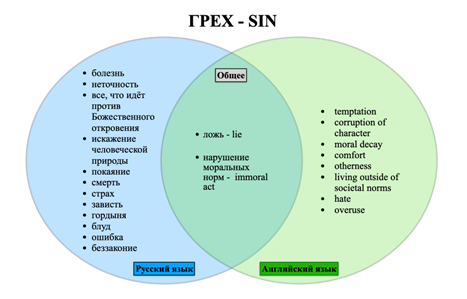
Comparative diagram of the association fields of the concept of грех/sin in Russian and English
The next concept for analysis is молитва/prayer. In the novel “Flavian,” the concept of молитва is a powerful spiritual reality capable of saving, healing, giving strength, and it acts as an active action of God, the Mother of God, and the saints in people’s lives: “По молитвам ему Господь и силы даёт, и разума духовного и любви обильно” .
In English, prayer appears more restrained and rational: as a request, pious practice, and a form of spiritual support, but without the intensive spiritual power characteristic of the Russian Orthodox tradition: “Fasting and prayer is all the diet we have” . It follows from this that in the the consciousness of English-speaking believers, the concept is expressed more specifically and pragmatically.
Below are the generalized results of the comparative analysis of the survey results (Fig. 2).
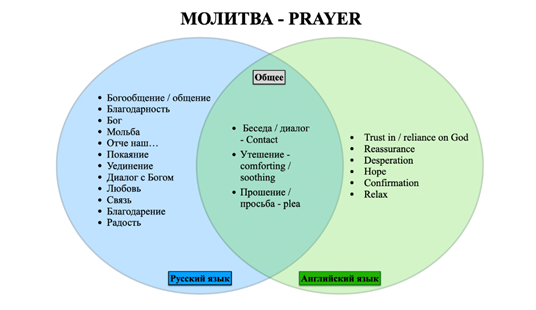
Comparative diagram of the association fields of the concept of молитва/prayer in Russian and English
3. Conclusion
The notion of the concept is examined through cognitive, cultural, and linguistic paradigms. It can be defined as an abstract category, that is, as a mental construct that functions as a unit of an individual's conceptual system, expressed through language. Conversely, the concept is also a concrete unit. In this case, the concept is expressed through linguistic devices that convey the most significant features of the concept necessary for the correct interpretation of the message.
The means of verbalizing concepts include lexical means, metaphors, symbols, and syntactic constructions that represent concepts in religious discourse with an emphasis on sacred vocabulary and ritual forms.
A religious literary work combines literary imagery with religious elements, performing aesthetic and ideological functions. It is a rich object of analysis, as it represents religious concepts through linguistic units and cultural context, which provides opportunities for more extensive study of this topic from a practical perspective.
In analyzing the means of verbalization of two key religious concepts — грех/sin and молитва/prayer — in Russian-language and English-language discourses, it was found that both cultures rely on common Christian ideas while at the same time creating distinct semantic and emotional emphases. In both languages, the concepts are associated with ideas of spiritual support, inner transformation, an individual’s turning to God, and the need for moral choice. However, the set of images, emotions, and value associations through which these concepts are described demonstrates pronounced cultural specificity.
The Russian linguistic picture of the world is distinguished by a deeper and more intimate understanding of these concepts. It is not purely pragmatic but is grounded in deep reflection and understanding of the full depth of the concept in question. English-language discourse, on the contrary, demonstrates a rational and contemplative and psychologically balanced interpretation of the same concepts. In the English tradition, there is less drama and ascetic rigour, and more attention is paid to individual responsibility, emotional balance, and personal growth.
These differences in verbalization demonstrate the deep-seated spiritual orientations of the two cultures, reflecting differences in how the same concepts are understood within the field of religious discourse.
Given the pilot nature of this study, which is based on relatively small groups of respondents, its results should be interpreted as preliminary. To confirm the discovered differences in the verbalization of the concepts, further surveys involving a wider range of native speakers representing different age, educational, and denominational groups are necessary. Expanding the corpus of literary texts and including other significant religious concepts will allow for a deeper comparative analysis and identifying systemic divergences in the religious worldview of the two cultures.